
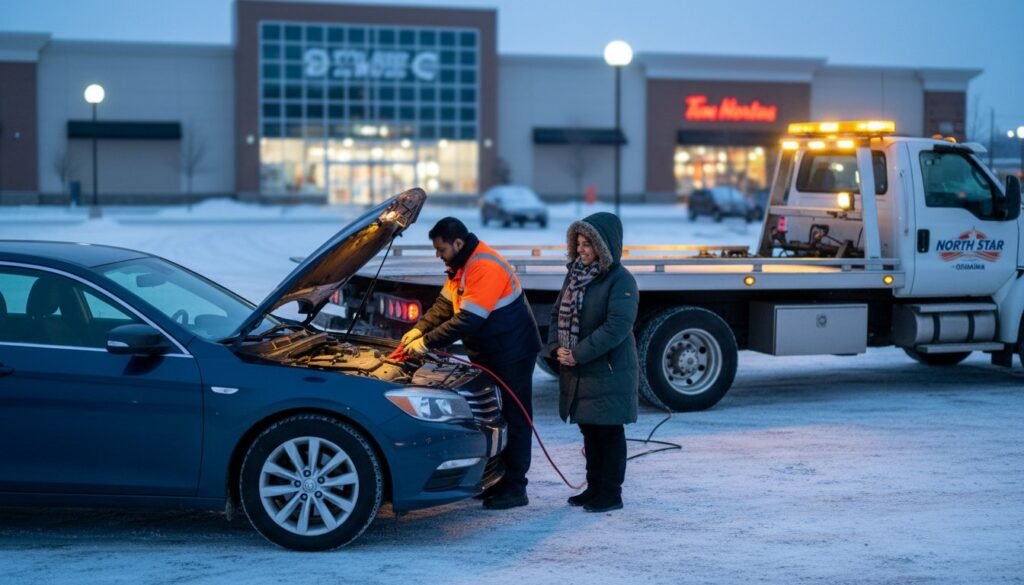
It’s 5:30 PM on a Tuesday in mid-January, and you’re standing in the Oshawa Centre parking lot with a dead battery and a trunk full of groceries. The temperature has dropped to -12°C, and your only goal is to get home safely before the 401 traffic peaks. You know you need to boost a car to get moving, but the fear of frying your vehicle’s sensitive C$2,000 engine control module or mixing up the cable sequence is enough to make anyone hesitate. It’s a high-stress situation that every driver in the Durham Region faces at least once during our unpredictable Ontario winters.
We realize that a stalled engine is more than just a mechanical failure; it’s a disruption to your peace of mind. This guide will teach you how to master the safe way to jump-start your battery without risking expensive electrical damage. You’ll learn the exact step-by-step sequence for modern vehicles and how to identify when your battery has finally reached its end. Whether you choose to handle it yourself or decide it’s time to call a Durham professional for expert hands, we ensure you’ll never be left stranded in the cold again.
Key Takeaways
- Understand how Oshawa’s unpredictable climate affects battery health and learn to recognize the difference between a simple parasitic drain and a dead cell.
- Master the professional “Red to Dead” connection sequence to safely boost a car while protecting yourself and your vehicle from dangerous short circuits.
- Navigate the complexities of 2026 vehicle architectures, including how to safely manage 12V systems in modern hybrids and EVs without frying sensitive electronics.
- Learn the “15-minute rule” for troubleshooting a failed jump-start and identifying when a clicking starter motor signals the need for expert roadside intervention.
- Gain peace of mind by knowing exactly when to transition from DIY efforts to calling a Durham professional for 24/7 damage-free assistance.
Understanding the Dead Battery: Why You Need to Boost a Car in Durham
Stuck in your driveway? It’s a frustrating start to the day. A battery boost provides the external electrical surge needed to crank an engine when your own battery lacks the juice. While it sounds simple, to boost a car safely requires more than just a pair of cables. It requires an understanding of why the failure happened in the first place. In Durham Region, this is a daily reality for many drivers, especially during the transition between seasons.
In Oshawa and the surrounding areas, we frequently see batteries fail due to extreme temperature swings or parasitic drains from dash cams and GPS units. Most lead-acid batteries have a lifespan of roughly 48 to 60 months. Attempting a jump start (vehicle) without checking these factors can lead to recurring issues or even permanent damage to your vehicle’s alternator. Our team focuses on a “peace of mind” approach, ensuring the boost is performed correctly to avoid fried sensors or blown fuses.
Safety is our priority. If you are stranded on the shoulder of Highway 401 or a busy stretch of Taunton Road, your focus must be on your surroundings before you even open the hood. Traffic moves fast in Durham. Rushing the process often leads to crossed cables or short circuits, which can result in costly electrical repairs reaching upwards of C$1,500 for a new Engine Control Module. We recommend staying inside your vehicle until professional help arrives if you are on a high-speed route.
The Impact of Ontario Winters on Battery Health
Sub-zero temperatures in Whitby and Ajax are the primary enemy of your vehicle’s starting system. When the mercury hits -18°C, a standard battery loses approximately 50% of its available cranking power. Meanwhile, the engine oil thickens, making the motor much harder to turn over. Short city trips often prevent the alternator from fully replenishing the energy used during a cold start. Cold Cranking Amps (CCA) is the critical metric for Canadian drivers, representing how much current a battery can deliver for 30 seconds at -18°C.
Pre-Boost Safety Checklist
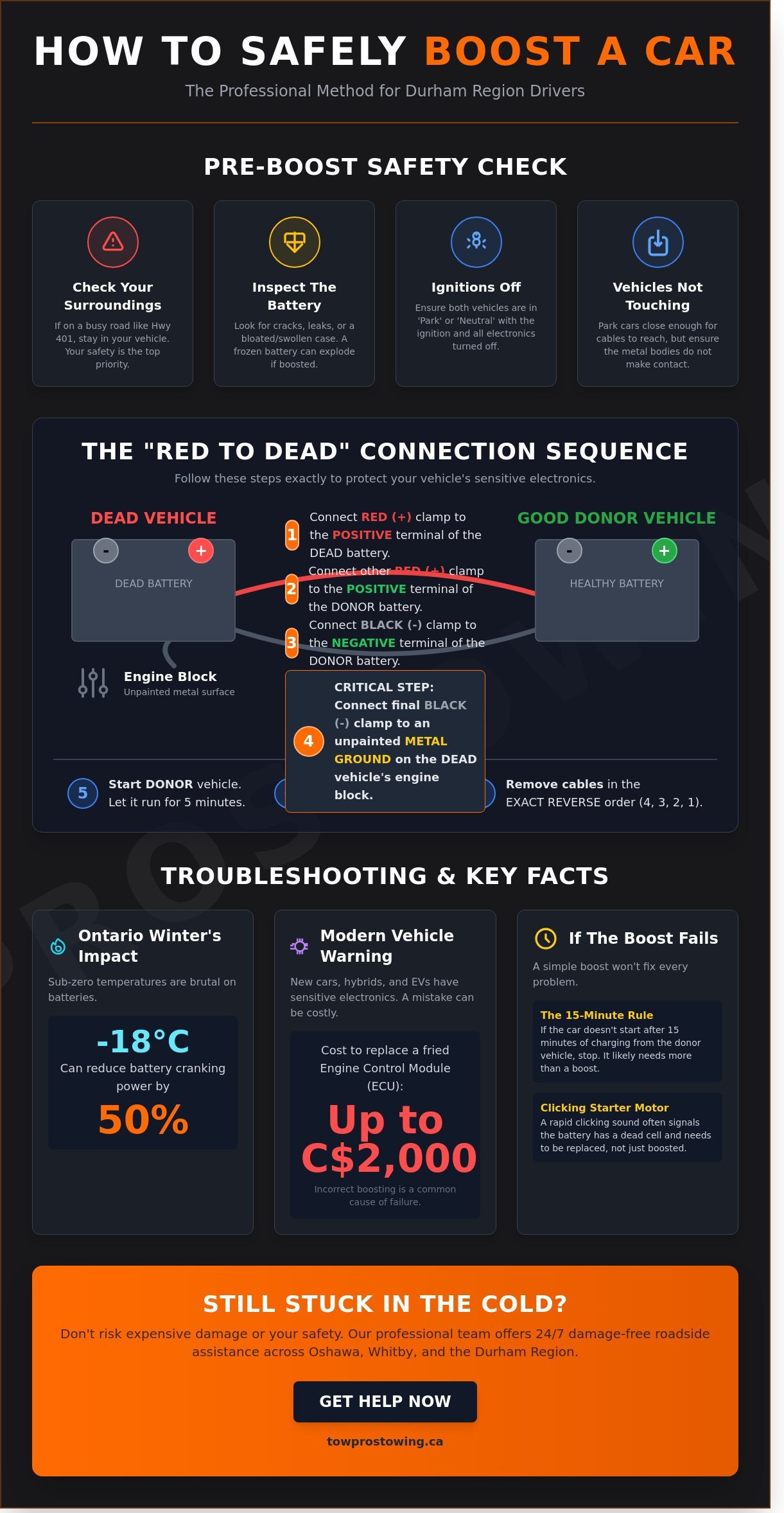
Before you try to boost a car, perform a quick visual inspection. Look for a bloated or cracked battery casing. If the battery looks swollen, it is likely frozen; attempting to boost it in this state can cause an explosion. You should also check for terminal corrosion, which appears as a white or blueish powder that blocks the flow of electricity. Always ensure both vehicles are in “Park” with their ignitions turned completely off before you begin the connection process. This simple step protects the sensitive electronics in both cars.
How to Boost a Car Step-by-Step: The Professional Method
A dead battery in Ajax often happens at the worst possible time. Knowing how to boost a car properly prevents expensive electrical damage and gets you back on the road. Safety is the priority. Start by positioning the donor vehicle close enough for cables to reach, but ensure the cars do not touch. If the metal bodies make contact, it can create a dangerous ground path before you even connect a cable.
Professional technicians use the “Red to Dead” sequence to minimize risks. First, connect the red positive clamp to the positive terminal of the dead battery. Then, attach the other red clamp to the donor battery. This specific order reduces the chance of accidental short circuits. Next, connect the black negative clamp to the donor battery’s negative terminal.
The final connection is the most critical for safety. Instead of attaching the last black clamp to the dead battery, find a clean, unpainted metal part of the engine block on the stalled car. Experts suggest this method to safely jump-start a car because it keeps potential sparks away from flammable hydrogen gases near the battery. Once connected, start the donor car and let it run for at least five minutes. This time allows a “surface charge” to build up in the depleted battery. Finally, start the stalled vehicle and remove the cables in the exact reverse order.
Essential Tools for the Job
Ajax winters are brutal on standard equipment. You should use 4-gauge or 6-gauge jumper cables. Lower gauge numbers mean thicker wire, which is necessary to carry enough current when it is -20°C. Portable lithium-ion jump packs are a modern alternative. They are compact and easy to store, but they often lose significant power in extreme cold. Every driver in the Durham Region should carry a basic roadside kit containing heavy-duty cables, work gloves, and a reliable flashlight. If your equipment isn’t up to the task, our expert roadside team provides dependable assistance across the city.
Avoiding Common DIY Boosting Mistakes
Arcing is a frequent danger during a DIY boost. This occurs when the metal clamps touch each other while connected to a live power source, creating intense heat and sparks. You must never smoke or use a lighter near a charging battery because lead-acid batteries release volatile hydrogen gas. If the cables feel hot to the touch, stop the process immediately. Excessive heat usually points to high electrical resistance or a short circuit. This can quickly melt cable insulation or fry sensitive vehicle computers, leading to repairs that cost thousands of dollars.
Modern Vehicles and Electronic Sensitivity: What Has Changed?
Cars have evolved into rolling computers. A typical 2026 model year vehicle contains up to 100 separate Electronic Control Units (ECUs) managing everything from fuel injection to cabin climate. These systems are incredibly delicate. When you attempt to boost a car using old-school methods, you risk sending a high-voltage transient through the vehicle’s sensitive CAN bus network. A single accidental spark can fry a powertrain control module, leading to repair bills that often exceed C$2,500 at an Ajax dealership. It is no longer just about turning over an engine; it is about protecting a complex digital architecture.
Modern vehicles also feature Start-Stop technology to improve fuel efficiency. These cars rely on specialized AGM (Absorbent Glass Mat) batteries. Unlike traditional flooded batteries, AGMs require precise charging profiles. Delivering a raw, unregulated surge of power can damage the internal fiberglass mats, reducing the battery’s lifespan by 40% or more. If you drive a luxury or tech-heavy vehicle, skipping the DIY approach ensures your warranty stays intact and your electronics remain safe.
Boosting Hybrids and EVs in Durham
Hybrids and Electric Vehicles (EVs) still utilize a standard 12V battery to “wake up” the high-voltage system. However, these 12V batteries are rarely located in the traditional engine bay. In many Tesla models or the Ford F-150 Lightning, you must access specific jump points behind a plastic trim panel in the frunk. Our team knows exactly where these points are located to avoid damaging the high-voltage traction battery. You should never use an EV to boost a traditional gas vehicle. The DC-DC converters in EVs are designed for steady low-voltage loads, not the 600-amp surge required by a combustion starter motor. Many new models now require activating a specific ‘Jump Start Mode’ through the infotainment screen before they will accept a charge.
Protecting Your Car’s Computer (ECU)
The moment jumper cables touch a battery, a voltage spike can occur. This surge happens in milliseconds, which is faster than a standard fuse can blow. We use professional-grade power packs equipped with integrated surge protectors to neutralize these spikes before they reach your ECU. Modern alternators are more sensitive to shock loads than older models because they utilize high-efficiency internal diodes that cannot withstand the sudden current draws common in manual boosting. Our technicians use “smart” cables that monitor polarity and current flow, ensuring the power delivery is smooth and controlled. We don’t just get you moving; we ensure your car’s brain remains perfectly healthy.
Dead battery? Don’t risk your vehicle’s expensive electronics. Our experts provide the damage-free service you need to get back on the road safely.
Troubleshooting: What to Do if the Boost Doesn’t Work
Sometimes you follow every step to boost a car but the engine still won’t turn over. It’s a frustrating situation that requires a calm, methodical approach. First, listen closely to the sound the vehicle makes when you turn the key. A rapid clicking sound usually indicates the starter motor is trying to engage but doesn’t have enough “cranking amps” to finish the job. If you hear nothing at all, the battery might be completely discharged or the connection is faulty.
Follow the 15-minute rule before giving up. If the donor vehicle has been connected for a few minutes and nothing happens, let it run at a high idle for a full 15 minutes. If the dead battery still won’t start the car after this period, the internal plates are likely too damaged to accept a charge. You should also check the basics. Ensure the clamps are tight and haven’t wiggled loose. Look for paint, dirt, or heavy rust on the grounding point. These contaminants block the flow of electricity and prevent a successful boost.
You can also test the alternator’s health during this process. If the car starts but stalls the moment you remove the jumper cables, the alternator isn’t doing its job. In a healthy system, the alternator takes over the electrical load once the engine is running. If it fails, your car is simply running off the temporary surface charge provided by the boost, which won’t last more than a few seconds.
Signs You Need a Battery Replacement
In the GTA East climate, batteries face extreme stress. We see -25°C winters and 30°C summers that accelerate chemical breakdown. Most experts recommend the “Three-Year Rule” for vehicles in Ontario. Once a battery passes the 36-month mark, its reliability drops by over 40 percent. If you see the battery icon stay lit on your dashboard, it’s a direct warning that the charging system is failing. A boost is often just a temporary fix for a dying cell. If you find yourself needing a jump-start more than once a week, your battery has reached the end of its functional life.
When DIY Fails: Assessing Your Options
Calling a friend for help is a common first instinct, but it carries risks. Consumer-grade jumper cables are often thin and lose significant voltage over their length. If you’re stranded in a low-light area of Bowmanville or Clarington, safety is your primary concern. Fiddling with cables in the dark can lead to dangerous sparks or reversed polarity. A professional battery boost service uses industrial-grade, high-amperage equipment. These power packs deliver a clean, stable surge of energy that consumer cables can’t match, ensuring your vehicle’s sensitive electronics stay protected. We arrive with the right tools to get you moving without the stress of DIY trial and error.
Stuck with a dead battery that won’t respond? Request a professional boost from Towpros Towing for a fast, damage-free resolution.
Professional Roadside Assistance in Oshawa and Whitby
Drivers across the Durham Region trust Towpros Towing as their first choice for reliable roadside support. We know that vehicle trouble happens at the worst possible times. Your battery won’t check your schedule before it fails. It might happen on a freezing Tuesday morning in Whitby or late on a Saturday night in Oshawa. Because batteries don’t wait for business hours, our team remains available 24/7 to ensure you aren’t left stranded. We bring professional equipment and a calm, capable attitude to every call.
Modern vehicles require a specialized touch. Today’s SUVs and luxury cars are packed with sensitive electronics that a standard set of cables might damage. Our technicians are experts who know exactly how to safely boost a car without risking a blown fuse or a fried control module. If the issue is more than just a drained battery, we’re prepared. We offer professional flatbed towing to get your vehicle to a repair centre without adding any wear or tear. We don’t just tow vehicles; we deliver peace of mind when you need it most.
Fast Response Times Across the Durham Region
Speed is essential when you’re stuck on the shoulder of a busy road. We strategically position our service vehicles near major transit hubs in Ajax, Pickering, and Oshawa to minimize your wait. This local focus allows us to arrive quickly, often within 30 to 45 minutes depending on traffic conditions. Our commitment to your peace of mind means we prioritize clear communication from the moment you call. You’ll receive honest pricing with no hidden fees. We believe that professional roadside support should be transparent and fair, especially when you’re in a stressful situation.
The Towpros Advantage: Safety and Reliability
We use professional-grade power packs designed to provide a steady, regulated flow of electricity. This prevents the voltage surges that often occur with cheap consumer cables. While Towpros Towing was officially established in 2022, our team brings 9+ years of hands-on industry experience to every job. We’ve seen every type of roadside challenge Ontario winters can throw at a driver. Our “Local Hero” approach means we treat your vehicle with the same care we’d give our own. Stuck with a dead battery? Contact Towpros Towing for an immediate boost!
Drive With Confidence Across Durham Region
A dead battery doesn’t have to ruin your schedule. Modern vehicles in 2026 require a precise touch to protect sensitive onboard computers; following the professional step-by-step method ensures you don’t cause an expensive electrical failure. Whether you are at the Whitby GO Station or parked in your Oshawa driveway, knowing how to safely boost a car is a vital skill for every driver in Ontario. If the cables don’t spark life back into your engine or you feel unsure about the process, professional help is just a phone call away.
Towpros brings 9+ years of roadside experience to every service call. We use damage-free professional equipment to protect your vehicle’s warranty and sensitive electronics. Our team remains available 24/7 across Oshawa, Whitby, and Ajax to ensure you are never stranded for long. We don’t just jump-start engines; we deliver peace of mind when you need it most. Trust our skilled technicians to get you moving again with speed and honesty.
Get a Fast Battery Boost in Durham – Call Towpros Now!
Stay safe on the roads and remember that expert help is always nearby to help you reach your destination.
Frequently Asked Questions
Can boosting a car damage the computer (ECU)?
Yes, an improper jump-start can send a high-voltage spike through your vehicle’s electrical system. Modern cars often contain up to 100 interconnected Electronic Control Units (ECUs) that are sensitive to power surges. Our technicians use professional grade, surge-protected equipment to ensure your vehicle’s sensitive electronics remain safe. If you’re unsure about the process, it’s safer to call a professional than risk a C$2,000 repair bill.
How long should I drive my car after getting a boost?
You should drive your vehicle for at least 30 minutes at consistent speeds to allow the alternator to recharge the battery. Aim for highway driving where possible, as higher RPMs help the charging process more effectively than idling in a driveway. If your battery is more than 4 years old, it may not hold this charge. We recommend visiting a service centre soon to test the battery’s health.
Is it safe to boost a car in the rain or snow?
It’s safe to boost a car in wet weather provided you follow strict safety protocols. You must keep the battery terminals and cable ends as dry as possible to prevent short circuits. Our team is trained to manage these conditions safely; we ensure that moisture doesn’t interfere with the connection. We handle the heavy lifting in the snow so you don’t have to worry about the elements.
What gauge jumper cables do I need for a Canadian winter?
You need heavy-duty 4-gauge or 2-gauge cables for reliable performance in Canadian winters. Thicker cables, represented by lower gauge numbers, allow more current to flow; this is essential when engine oil thickens at -20°C. Standard 8-gauge or 10-gauge cables often fail to provide enough power to start a frozen engine. Investing in a high-quality set ensures you aren’t stuck when the temperature drops.
Can I boost a hybrid car with a regular gas vehicle?
You can usually use a gas vehicle to boost a car with a hybrid system, but only to jump the 12V auxiliary battery. Never attempt to boost the high-voltage hybrid battery itself. You should also avoid using a hybrid vehicle to provide a boost to another car, as the delicate electrical systems aren’t designed for that load. Always consult your owner’s manual for specific terminal locations.
What if my car starts but then dies again shortly after the boost?
If your engine dies immediately after removing the cables, your alternator likely isn’t charging the battery. The alternator is responsible for powering the electrical system while the engine runs. When it fails, the car relies solely on the battery, which quickly drains again. In 85 percent of these cases, the vehicle will require a tow to a repair shop for a charging system replacement.
Why is my battery dead even though I didn’t leave the lights on?
Extreme cold is the most common culprit, as a lead-acid battery loses about 50 percent of its cranking power once temperatures hit 0°C. Parasitic drains from onboard computers or a faulty glovebox light can also deplete the charge over 24 hours. If your battery is older than 5 years, it may simply have reached the end of its chemical lifespan. We can diagnose these issues on-site quickly.
How much does a professional battery boost service cost in Oshawa?
Professional roadside assistance rates in the Durham Region typically range from C$70 to C$120 based on 2023 market data. While some providers charge flat fees, others adjust based on extreme weather conditions or the distance travelled. We prioritize honesty and transparency in our pricing. Contact us directly for an immediate, accurate quote to get you back on the road without delay.