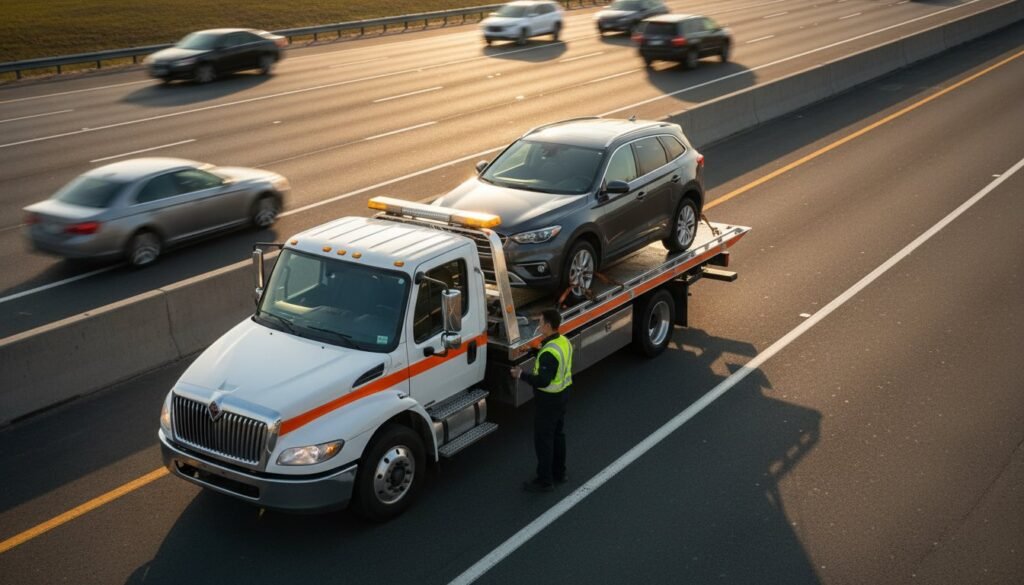
Imagine you’re stuck on the shoulder of the 401 near Whitby at 5:30 PM, watching traffic fly past while you wait for help. You’ve heard horror stories about AWD systems being shredded by traditional tow hooks, and now that your dash is lit up, those stories feel very real. It’s a common fear for Durham Region drivers, and unfortunately, many believe that any tow truck will do the job safely regardless of the vehicle type.
We understand that being stranded is stressful enough without worrying about a C$5,000 repair bill for a ruined drivetrain. You’re right to be cautious because your vehicle is a major investment that deserves expert handling. In this guide, you’ll discover the truth about damage-free transport and why a flatbed tow truck is often the only safe choice for modern vehicles on Ontario roads. We’re going to debunk the most common towing myths and show you exactly how to protect your car while finding a reliable, honest provider in Oshawa or Whitby.
Key Takeaways
- Learn how the “tilt and load” mechanism eliminates dragging to ensure your vehicle stays completely off the pavement during transport.
- Discover why traditional towing methods are dangerous for modern transmissions and why a flatbed tow truck is often your only safe option.
- Realize why professional securement points are just as critical as the equipment itself for achieving a truly damage-free result.
- Understand the specific safety protocols required for high-speed recoveries on the 401 and throughout the Durham Region.
- Learn how to vet local towing companies over the phone to ensure your vehicle is in expert hands before they arrive on-site.
What is a Flatbed Tow Truck? The Basics for Durham Drivers
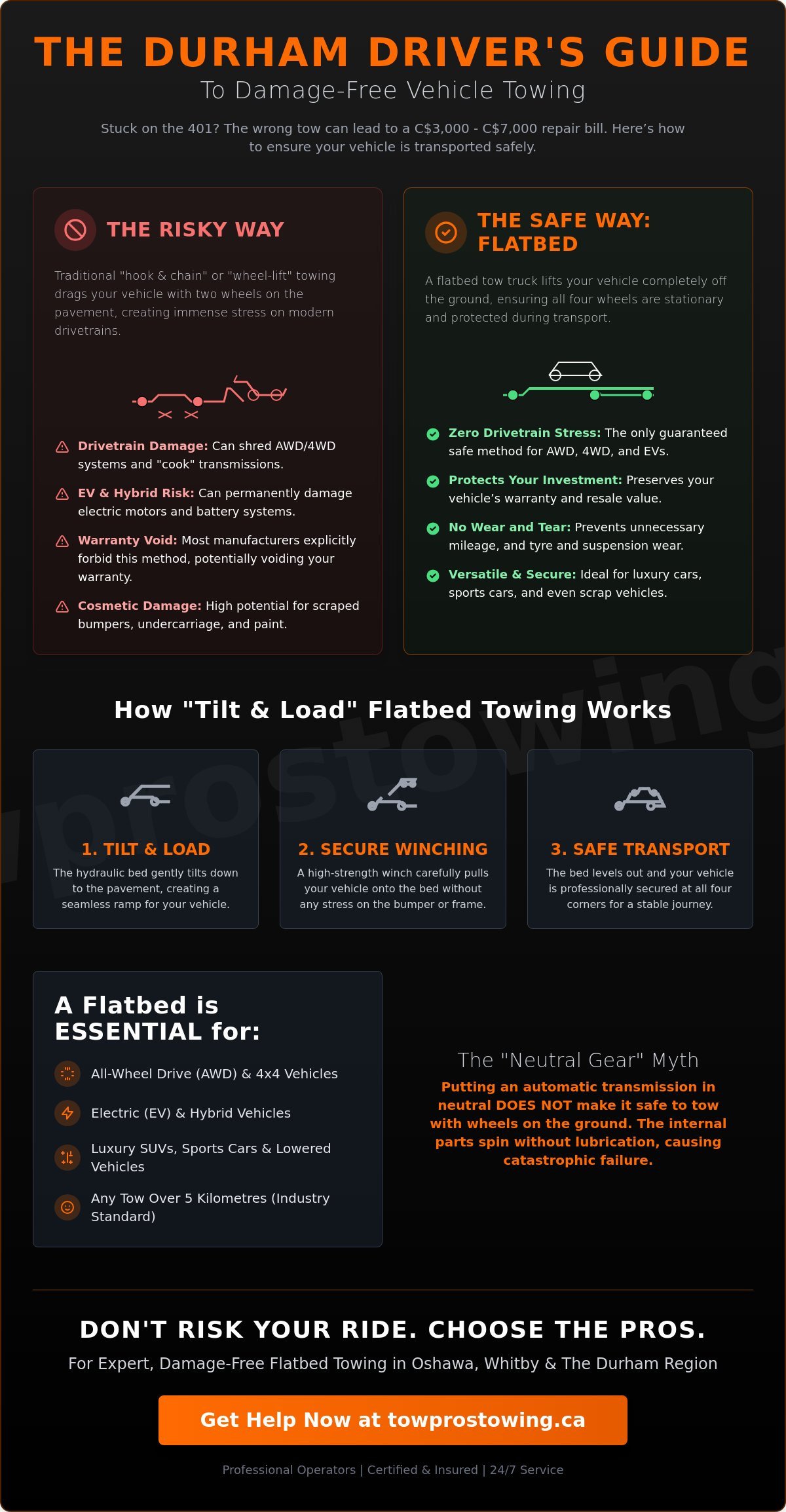
Stuck on the shoulder of the 401? It is a high-stress situation that requires a calm, professional solution. A flatbed tow truck is the modern answer to roadside emergencies in Ontario. Unlike older recovery vehicles, a flatbed features a long, hydraulic platform that can tilt and slide back until the rear edge touches the ground. This “Tilt and Load” mechanism creates a temporary ramp, allowing your vehicle to be moved without the harsh dragging associated with older methods.
In the past, the “hook and chain” method was common, but it often led to scratched paint or bent bumpers. Today, the industry has shifted toward “damage-free” transport. Whether you are moving a rusted scrap car to a recycling centre or transporting a luxury SUV to a dealership in Oshawa, the flatbed is the most versatile tool in a driver’s arsenal. It provides a level of safety that ensures your vehicle arrives in the same condition it was in when it was picked up.
How the Tilt-and-Load System Protects Your Vehicle
The hydraulic process is designed for precision. Our operators lower the bed to create a shallow angle, which is essential for low-clearance vehicles. A high-strength winch then safely pulls the vehicle onto the platform. This method eliminates stress on the car’s bumper and suspension. Once the vehicle is secured, the bed returns to a horizontal position. Because the car remains completely stationary throughout the entire transport process, there is zero risk of transmission wear or alignment issues. We don’t just move cars; we put them in expert hands to deliver peace of mind when you need it most.
Flatbed vs. Wheel-Lift: When Does the Truck Matter?
While there are different types of tow trucks available across the Durham Region, they serve different purposes. A wheel-lift truck uses a metal yoke to lift either the front or rear wheels, leaving the other two rolling on the pavement. This is often necessary in tight spots like underground parking garages in downtown Whitby where a large flatbed cannot fit.
However, for the vast majority of calls, flatbed towing is the superior option. Industry standards suggest that for any distance over 5 kilometres, a flatbed is the safest choice for your vehicle’s drivetrain. It prevents unnecessary wear and tear on your tires and protects all-wheel-drive systems from mechanical damage. When you choose a flatbed tow truck, you are choosing the most reliable way to get back on track without the worry of hidden damage.
Myth: “All Cars Can Be Towed with a Hook and Chain”
You’re stuck on the shoulder of the 401, and the only thing on your mind is getting home. It is tempting to think that any truck with a winch can solve your problem. This “any truck will do” mindset is one of the most dangerous misconceptions in the industry. Modern vehicles are no longer simple mechanical boxes; they are rolling computers with sensitive hardware. Using an outdated hook and chain method on a 2024 model is a recipe for a financial disaster. It can lead to a ruined transfer case or a shredded differential, with repair bills often ranging from C$3,000 to C$7,000 depending on your make and model.
Your vehicle’s long-term health is at stake the moment the hooks are attached. Beyond the immediate mechanical repair costs, the wrong towing method can actually void your manufacturer’s powertrain warranty. Most modern manuals explicitly state that the vehicle must be transported on a flatbed tow truck to prevent internal wear. Professional operators who hold professional towing certifications understand these high-stakes risks. They prioritize safety over speed because they know your peace of mind depends on a damage-free arrival.
The Drivetrain Dilemma: AWD, 4WD, and Electric Vehicles
All-Wheel Drive (AWD) and 4WD systems are standard for many Durham Region drivers, but they require specific care. These systems mechanically link the front and rear wheels. If you tow an AWD car with two wheels on the ground, the gears inside the transmission spin at violent speeds without proper cooling. Electric vehicles (EVs) face even higher risks due to regenerative braking. Dragging an EV can force the motor to generate electricity it cannot dissipate, potentially frying the entire battery system. Drivetrain damage is often invisible until you try to drive again.
The “Neutral Gear” Misconception: Why Rolling Isn’t Always Safe
Many drivers believe that shifting into neutral makes a car safe for a traditional wheel-lift tow. This is a myth that leads to “transmission cook.” Most modern automatic transmissions rely on a pump driven by the engine to circulate vital lubrication. When the engine is off but the wheels are spinning during a tow, those gears are grinding together without any oil. Over a long distance, the heat builds up until the internal components are toast. Using a flatbed tow truck ensures your car stays stationary and safe. If you find yourself in a bind, putting your vehicle in expert hands is the only way to guarantee it stays roadworthy for the long haul.
The Truth About Damage-Free Towing: Why the Bed is Only Half the Battle
Most drivers in Durham Region assume that booking a flatbed tow truck is an automatic guarantee of safety. While the equipment is superior to a traditional hook-and-chain setup, the truck is only as good as the person operating the controls. A 2023 industry report suggests that nearly 30% of transport-related vehicle claims involve improper loading techniques rather than equipment failure. True damage-free service isn’t just a marketing slogan; it’s a combination of the right deck and the right hands. At Towpros, we realize that your vehicle is a major investment, and we treat it with the technical respect it deserves.
Beyond the Bed: The Importance of Specialized Strapping
Professional towing requires a delicate balance of force and finesse. We never wrap heavy chains around your vehicle’s axle or suspension components. This outdated practice can bend control arms or ruin your wheel alignment before you even reach the repair shop. Instead, we utilize specialized soft straps and J-hooks designed for specific vehicle makes. Our team uses eight-point tie-down systems. This method secures each tire individually, ensuring the car stays stationary without putting unnecessary stress on the chassis or frame. We take extra care to protect the finish of your rims, using padded guards so your wheels look exactly the same when they come off the bed as they did when they went on.
Operator Expertise: The Human Element in Towing
Experience is what turns a standard tow into a professional transport. With 9+ years of hands-on industry experience, our operators understand the physics of a flatbed tow truck better than anyone. Before we even engage the winch, we perform a detailed pre-tow inspection to identify existing damage and determine the best hook-up points for your specific model. This is especially vital for low-clearance vehicles or EVs where battery packs are sensitive to pressure.
Managing weight distribution is another critical skill that separates the pros from the amateurs. If a car is positioned too far forward or back on the bed, it affects the truck’s braking and stability on the 401 or local Durham roads. Our drivers ensure the load is centred perfectly for a smooth, vibration-free ride. We don’t just tow vehicles; we deliver peace of mind when you need it most. Our disciplined approach ensures your car is in expert hands from the moment we arrive until the final drop-off.
Navigating Durham Region Roads: Flatbed Towing on the 401 and Beyond
Driving through Pickering, Whitby, and Oshawa presents a unique set of challenges. Highway 401 is one of the busiest corridors in North America, with some sections in the Durham Region seeing over 400,000 vehicles daily. When your car breaks down on this high-speed stretch, the situation is urgent. You aren’t just looking for a ride; you’re looking for a way to get out of harm’s way. Our team understands that every second spent on the shoulder increases risk. We prioritize quick response times to clear dangerous road hazards, ensuring that your vehicle is moved to a safe location without delay.
Highway Safety: Why Flatbeds are the Safer Choice for 401 Recoveries
Stuck on the shoulder? It’s a high-stress spot. A flatbed tow truck is the gold standard for highway recoveries because it allows for a “load and go” operation. Instead of spending time adjusting tow bars or clearing the drivetrain, our experts winch your vehicle directly onto the platform. This efficiency keeps our drivers and your vehicle away from active traffic lanes. Stability is another major factor. When large transport trucks roar past at 100 km/h, the resulting wind gust can cause a vehicle on a traditional hook to sway dangerously. A flatbed keeps your car secured on a solid deck, providing a smooth and damage-free journey even at highway speeds.
3-Step Safety Guide for 401 Breakdowns:
- Move Right: Pull as far onto the right shoulder as possible, away from the moving traffic lanes.
- Stay Inside: Keep your seatbelt on and stay inside the car. The vehicle’s metal frame is your best protection.
- Signal Clearly: Turn on your hazard lights immediately to alert other drivers and help our tow operator locate you.
Winter Towing in Oshawa and Whitby: Managing Ice and Slush
Durham Region winters are notorious for lake-effect snow and sudden icy patches. When the temperature drops, we see a surge in calls. Often, these situations begin with battery boost services during a January cold snap, but if the car won’t start or is stuck in a drift, a tow becomes necessary. Using a flatbed tow truck during winter is essential for protecting your investment. Traditional towing methods leave your car’s undercarriage exposed to a constant spray of salt, slush, and road chemicals. This mixture can corrode brake lines and electrical sensors. By elevating the entire vehicle, we keep it clean and protected from the harsh elements.
If your car has slid into a snowbank, winching it out requires precision. We use our 9+ years of industry experience to ensure the recovery is handled with expert hands. We don’t just tow vehicles; we deliver peace of mind when you need it most. Whether you are facing a blizzard in Whitby or a flat tire in Pickering, we are ready to help. Contact Towpros Towing for immediate roadside assistance.
Choosing the Right Flatbed Towing Service in Oshawa and Beyond
Local expertise in the Durham Region is a safety requirement, not just a convenience. When you are stranded on the side of the 401 or a busy intersection in Oshawa, you need a team that knows the local geography intimately. A driver who understands the traffic flow near the Oshawa Centre or the backroads of Bowmanville can reach you faster and position their equipment more safely. This local knowledge reduces your time spent in a high-stress situation on the shoulder of the road.
Before you agree to a service, vet the company over the phone. Ask if they are sending a dedicated flatbed tow truck or a standard hook and chain model. Request a clear breakdown of their pricing, including the hook-up fee and the rate per kilometre. Honest companies provide transparent quotes and realistic arrival times. If a dispatcher seems vague about costs or equipment, it’s a sign to call someone else. Your vehicle is a major investment; it deserves a service that prioritizes honesty and professional standards.
Why Towpros Towing is the Durham Region’s Trusted Choice
We built Towpros Towing on a foundation of reliability and expert skill. Established in 2022, our team brings over 9 years of hands-on industry experience to every call. We don’t just tow vehicles; we deliver peace of mind when you need it most. Our 24/7 emergency response ensures that help is always available across Ajax, Pickering, and Bowmanville. We use modern, well-maintained flatbed equipment designed to handle light-duty vehicles with precision. Whether you drive a lowered sports car or a standard SUV, your vehicle is in expert hands with our damage-free transport methods.
What to Expect When You Call for a Flatbed in Ajax or Pickering
The process starts the moment you pick up the phone. To help our dispatchers work quickly, have your exact location, vehicle make and model, and your destination ready. We prioritize your safety, so we will provide an immediate estimated time of arrival. Once our flatbed tow truck arrives, the procedure is straightforward:
- Site Assessment: The driver evaluates the area to ensure a safe loading environment.
- Secure Loading: Your vehicle is carefully winched onto the flatbed deck, avoiding any contact with the ground.
- Four-Point Tie-Down: We secure the car using professional-grade straps to prevent movement during transit.
- Transport: Your vehicle is delivered directly to your chosen repair shop or home without extra wear on the drivetrain.
Stuck on the road? Don’t let the stress take over. Contact Towpros Towing for 24/7 Flatbed Service and get the professional help you deserve today.
Drive with Confidence Across the Durham Region
Choosing the right equipment shouldn’t be a guessing game when you’re stuck on the shoulder of the 401. You’ve learned that a flatbed tow truck is the safest choice for protecting your vehicle’s transmission and frame, especially for modern AWD models and luxury cars. It isn’t just about the truck itself; it’s about the precision of the loading process and the skill of the operator. Moving a vehicle safely requires more than just a winch; it takes a commitment to damage-free standards that protect your investment from start to finish.
With 9+ years of hands-on industry experience, our team understands the unique challenges of navigating Oshawa, Whitby, and Pickering roads. We provide a 24/7 emergency response because roadside trouble doesn’t follow a schedule. Whether you’re driving a high-performance sports car or a family SUV, we treat every vehicle with the specialized care it deserves. We don’t just tow vehicles; we deliver peace of mind when you need it most. Trust the experts who know Durham’s streets and prioritize your safety above all else.
Need a safe tow? Request a Flatbed Tow Truck from Towpros Towing now!
Stay safe on the road and know that help is always just a quick call away.
Frequently Asked Questions
Is a flatbed tow truck more expensive than a regular tow truck?
Flatbed towing usually costs more than traditional wheel-lift methods because the equipment is more specialized and expensive to operate. In Ontario, you can expect to pay a premium of C$25 to C$50 over the standard hook-up fee for this service. This small investment protects your vehicle from transmission wear and tire damage, providing peace of mind during the trip.
Can an AWD car be towed on two wheels if the distance is short?
No, you should never tow an All-Wheel Drive (AWD) vehicle on two wheels, even for a distance as short as two kilometres. Doing so can cause permanent, expensive damage to the centre differential and drivetrain because the wheels are forced to spin at different speeds. A flatbed tow truck is the only safe solution for AWD vehicles because it keeps all four wheels securely off the ground.
Why do I need a flatbed for my Tesla or other electric vehicle?
Electric vehicles require flatbed transport because their electric motors are often permanently engaged with the wheels. If an EV is towed with its wheels on the ground, the motor can generate electricity and cause the battery or power electronics to overheat. Tesla’s official service guidelines mandate flatbed transport to prevent mechanical failure or potential fire risks, ensuring your car stays in expert hands.
How long does it typically take for a flatbed to arrive in Oshawa or Whitby?
Our team typically arrives at scenes in Oshawa or Whitby within 30 to 45 minutes of your call. Response times can vary based on traffic conditions on the 401 or Highway 7, but we prioritize urgent roadside emergencies to get you home safely. We are local to the Durham Region, so our drivers know the shortcuts to reach you without delay.
Will a flatbed tow truck damage my low-clearance sports car?
A flatbed tow truck is the safest way to move a sports car because it prevents the front bumper from scraping on the pavement. We use specialized racing ramps and wooden planks to create a shallow loading angle for cars with less than 10 centimetres of ground clearance. This professional method ensures a damage-free transport for high-end vehicles like Porches or lowered sedans.
What happens if my car is stuck in a parking garage with low clearance?
Standard flatbeds cannot enter parking garages with a clearance height of less than 2.1 metres. If you’re stuck in a tight spot, we use a low-profile wrecker to pull your vehicle out of the structure first. Once the car is in a clear, open area, we can safely transition it to a flatbed for long-distance transport if your vehicle’s drivetrain requires it.
Does insurance cover the cost of a flatbed tow truck in Ontario?
Most Ontario drivers are covered for towing if they have the OPCF 35 endorsement on their insurance policy. This specific add-on typically covers emergency road service costs up to a set limit, such as C$50 or C$100 per incident. We provide honest, detailed invoices that you can submit to your insurance provider or credit card company to help you get your money back quickly.