Your vehicle’s all-wheel drive system is a complex piece of engineering that can be ruined in under five minutes if it is hooked to a standard tow truck incorrectly. When you are searching for all-wheel drive vehicle towing Oshawa residents can trust, the choice between a traditional wrecker and a flatbed is not just about preference; it is about protecting your transmission. You likely already feel the stress of being stranded in heavy traffic or harsh winter weather. The last thing you need is a massive repair bill for a damaged differential because a driver did not understand your car’s specific mechanics.
We agree that your peace of mind is the priority when your car is off the road. This guide will show you why specialized flatbed transport is the only safe way to move an AWD vehicle to a local repair centre without voiding your warranty. You will learn about the strict January 1, 2024, TSSEA certification standards that every Oshawa driver should check before signing a consent form. We also preview the mechanical reasons why improper towing methods lead to catastrophic drivetrain failure and how our 9+ years of experience keep your vehicle in expert hands.
Key Takeaways
- Understand why traditional “two-wheels-up” towing causes rapid heat build-up and catastrophic damage to your vehicle’s centre differential.
- Discover why specialized flatbed transport is the only safe standard for all-wheel drive vehicle towing Oshawa drivers should use to prevent drivetrain failure.
- Learn the essential safety protocols for waiting on the shoulder of the 401 and how to verify your AWD status before the truck arrives.
- Realize the importance of hiring a TSSEA-certified professional to ensure your vehicle stays in expert hands and your warranty remains valid.
- Identify the critical differences between flatbed and dolly towing so you can make an informed choice during a high-stress roadside emergency.
Why AWD Vehicles Require Specialised Towing in Oshawa
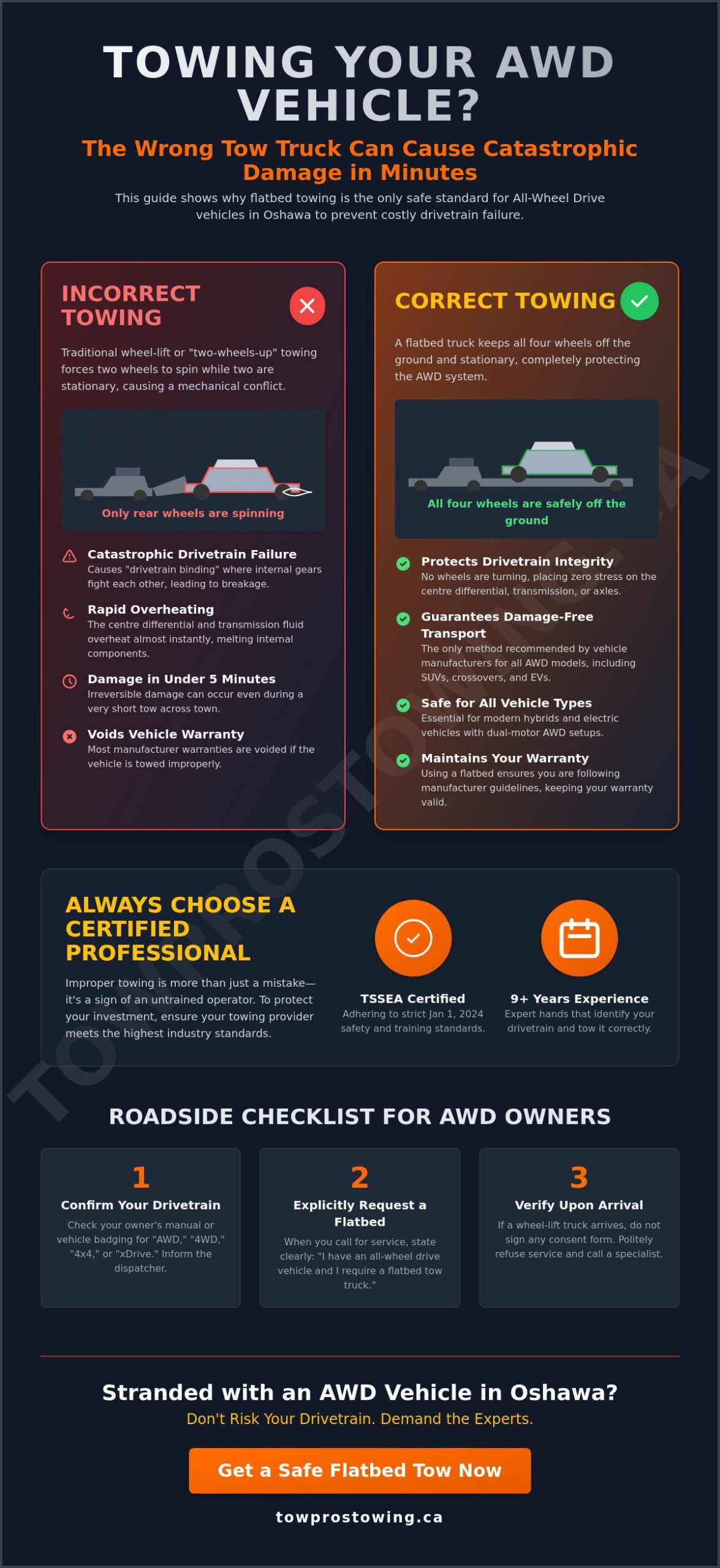
An All-Wheel Drive (AWD) system is a sophisticated piece of machinery designed to send power to all four wheels at the same time. While this is perfect for navigating a slushy morning on Taunton Road, it creates a massive headache during a breakdown. Traditional towing methods often involve lifting only two wheels off the pavement. For a front-wheel drive car, this is fine. For an AWD vehicle, it is a recipe for a mechanical disaster. Because the front and rear axles are mechanically linked, forcing one set of wheels to spin while the others are stationary puts immense stress on the centre differential. This component is not designed to handle that kind of speed differential for more than a few seconds.
When you call for all-wheel drive vehicle towing Oshawa services, you are not just looking for a ride to the shop. You are looking for a way to preserve your drivetrain. A standard wheel-lift tow can cause the transmission fluid to overheat almost instantly, leading to internal component melting. This is why a damage-free promise is the only standard we accept. We use flatbed trucks to ensure every wheel remains stationary on a solid platform throughout the journey. This approach eliminates the risk of drivetrain binding and protects your high-value investment from the moment we arrive.
The Rise of AWD Vehicles in the Durham Region
Oshawa residents have shifted heavily toward light trucks and SUVs over the last few years. In fact, while passenger car sales dropped by 18.2% in early 2026, the demand for versatile AWD crossovers remained steady. Modern electric vehicles and hybrids have also flooded the local market; most of these come with dual-motor AWD setups by default. Whether you drive a Subaru Crosstrek or a Tesla Model Y, the mechanical requirements for all-wheel drive vehicle towing Oshawa remain the same. Even a short tow across a parking lot on two wheels can lead to permanent gear stripping. Our team brings 9+ years of hands-on experience to every call, ensuring we identify your drivetrain type before we ever hook up.
Oshawa Winter Towing: Icy Roads and AWD Safety
Winter in the Durham Region presents unique challenges for vehicle recovery. If you find yourself in a snowbank off the 401, the recovery process is more complex than a simple pull. Because AWD vehicles distribute traction across all four corners, they can become deeply wedged in ways that front-wheel drive cars do not. Improper winching can snap CV axles or damage the delicate sensors used by your car’s stability control system. For safe extraction, you need professional winching and recovery services that prioritize the integrity of your suspension. We focus on delivering peace of mind by using precise attachment points that avoid body and frame stress, even in the middle of a February blizzard.
The Mechanics of Damage: What Happens During Improper Towing
To understand why all-wheel drive vehicle towing Oshawa specialists insist on flatbeds, you must look at the centre differential. This component acts as the mechanical bridge between your front and rear axles. In a standard two-wheel-up tow, the wheels on the ground are forced to spin at highway speeds while the wheels on the tow arm remain stationary. This creates a massive speed discrepancy within the drivetrain. The centre differential tries to compensate, but it is designed for cornering, not for sustained high-speed differences. This results in a phenomenon known as drivetrain binding, where internal gears effectively fight against each other until a component fails.
The friction generated by this internal conflict is intense. According to NHTSA towing safety guidelines, using a dolly or traditional hook for AWD vehicles can lead to immediate and severe mechanical failure. When the internal components reach critical temperatures, the metal expands and the lubrication breaks down. This often leads to a seized transfer case before you even reach the repair centre. If you find yourself stuck on the side of a busy road, choosing a provider that offers professional flatbed service is the only way to avoid these expensive consequences.
Transmission and Differential Overheating
Internal heat damage correlates directly to towing speed; the faster the tow truck travels, the more rapidly your AWD components will overheat and melt. Replacing a burnt-out AWD transfer case is a major expense that often involves weeks of downtime at a repair shop. Subtle signs of damage might not appear until three or four days after the tow. You might notice a low-frequency hum, a slight vibration during acceleration, or “shuddering” when making tight turns. By the time these symptoms surface, the internal gears have already begun to shed metal shavings into the oil, necessitating a full system teardrop.
Why Towing in Neutral Isn’t a Safety Net
Many drivers believe that putting an AWD car in neutral allows for safe two-wheel towing, but this is a dangerous myth. Most modern AWD systems rely on an internal lubrication pump that only functions when the engine is running. When the wheels spin during a tow with the engine off, the gears move without any fresh oil circulation. This lack of cooling is especially dangerous for the sophisticated dual-clutch and automatic transmissions found in many 2026 model vehicles. Without the engine providing power to the pump, the transmission is essentially running dry, leading to warped clutch plates and permanent gear scarring in as little as five kilometres of travel.
Flatbed vs. Dolly Towing for AWD Cars: Making the Right Choice
When you call for all-wheel drive vehicle towing Oshawa residents often wonder if a standard truck with dollies is sufficient or if a full flatbed is required. Flatbed towing involves loading the entire vehicle onto a hydraulic platform, ensuring no wheels touch the pavement. This is the manufacturer-recommended method for nearly every AWD brand, from Subaru to Audi. While dollies provide a workaround, they don’t offer the same safety margins as a dedicated flatbed truck. Understanding how to safely tow an all-wheel drive vehicle is critical for any operator to prevent the heat-related failures discussed earlier.
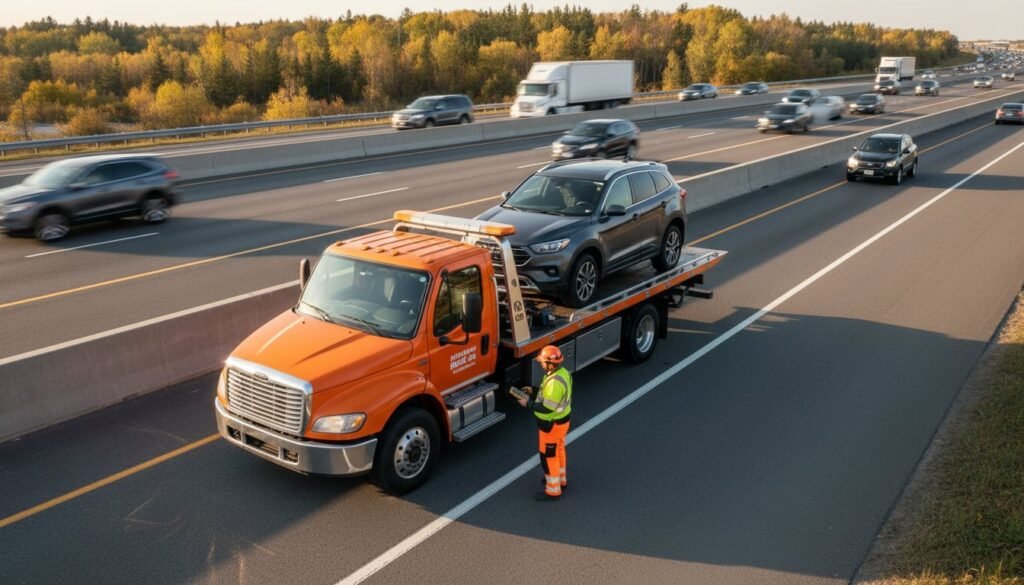
Setup time varies between the two methods. A flatbed is generally faster to load, as the driver simply winches the car onto the bed. Dollies require the operator to manually lift each wheel and secure a secondary frame. This extra handling increases the risk of human error, especially during a high-stress breakdown on the shoulder of the 401. Using a flatbed ensures your vehicle is secured in seconds, moving you away from traffic and toward safety without delay.
The Benefits of Full Flatbed Transport
The primary advantage of a flatbed is “zero-mileage” wear on your drivetrain. Since the vehicle is completely stationary, there is no risk of internal gear friction or heat build-up. Beyond the mechanics, flatbed towing provides a physical barrier against road debris. Oshawa’s local roads often suffer from potholes and loose gravel, especially after a spring thaw. Keeping your car elevated protects the undercarriage and suspension from impact damage. For luxury AWD models with low ground clearance, this method is a necessity to avoid bumper scrapes and body damage.
When Are Towing Dollies Used?
Towing dollies are typically reserved for specialized scenarios where a large flatbed truck cannot fit. You’ll often see them used in low-clearance areas like underground parking garages at the Oshawa Centre or tight residential alleyways. They work by placing a small set of wheels under the vehicle’s tires, effectively lifting the car off the ground. This requires significant technical skill from the operator to ensure the vehicle is balanced and the straps are tight. However, for highway recovery or long-distance transport, a full flatbed remains the preferred choice. Dollies have lower speed ratings and can become unstable on uneven pavement, making them a secondary option for most all-wheel drive vehicle towing Oshawa situations.
Preparing Your AWD Vehicle for Towing in the Durham Region
Breaking down on the shoulder of the 401 or a busy local street like Ritson Road is a high-pressure situation. Your first priority is safety. If you can, move your vehicle as far onto the right shoulder as possible. Turn on your hazard lights immediately to alert other drivers. If you are on a high-speed highway, it’s often safest to stay inside your vehicle with your seatbelt fastened until help arrives. Once you have secured your safety, the next step is ensuring you receive the correct all-wheel drive vehicle towing Oshawa service to protect your car’s drivetrain.
How to Confirm Your Car is AWD Under Stress
In the heat of the moment, you might forget your car’s specific drivetrain. Look for badges on the rear trunk or side panels; common labels include AWD, 4WD, All-Wheel Control, or brand-specific terms like Quattro, 4Matic, and xDrive. If the exterior is covered in road salt or grime, check the driver-side door jamb. There is usually a manufacturer sticker there that lists drivetrain specifications along with tire pressure. If you still can’t find a definitive answer and don’t have the owner’s manual handy, always tell the dispatcher the vehicle is AWD. It’s better to send a flatbed truck to a front-wheel drive car than to risk a “two-wheels-up” tow on a system that can’t handle it.
Communicating with Your Oshawa Towing Dispatcher
When you call for assistance, being specific helps the dispatcher send the right equipment the first time. Provide the following details clearly:
- The exact make, model, and year of your vehicle.
- Your precise location, using landmarks, cross-streets, or highway mile markers.
- The fact that your vehicle is All-Wheel Drive.
- Whether the car is in an accessible spot or stuck in a difficult location like a ditch or a low-clearance parking garage.
Ask specifically for a flatbed truck to avoid any “hook-and-chain” surprises when the driver pulls up. If you are heading to a local repair centre, ensure the driver knows the destination before they start loading. Documenting the condition of your car is also vital. Take four or five clear photos of the exterior, including the bumpers and wheels, before the vehicle is winched onto the platform. This provides peace of mind and clear evidence that your car was handled with care from the start. If you need immediate assistance from a team that understands these technical requirements, request a quote for damage-free towing from our certified experts.
Why Towpros Towing is Oshawa’s AWD Specialist
Choosing a towing partner is about more than just finding a truck with a winch. It’s about finding a team that understands the high-stakes engineering of your drivetrain. At Towpros Towing, we bring 9+ years of hands-on industry experience to every call. Since our establishment in 2022, we’ve focused on a single mission: delivering peace of mind when you need it most. When you require all-wheel drive vehicle towing Oshawa residents can rely on, our expert hands treat your vehicle with the same respect we’d show our own. We operate 24/7 across Oshawa, Whitby, and the entire Durham Region because we know that mechanical failures don’t follow a schedule.
Our commitment to business excellence means we don’t just move cars; we protect your investment. We understand the stress of being stranded in winter weather or heavy traffic. Our operators are trained to project a sense of immediate relief and calm authority. By the time our flatbed arrives, the hardest part of your day is already over. We prioritize honesty and politeness in every interaction, ensuring you feel supported from the first phone call until your vehicle is safely dropped off at a local repair centre.
Equipped for Modern AWD Technology
Our fleet consists of modern flatbed trucks specifically designed to handle the unique requirements of AWD cars and low-clearance luxury models. We don’t rely on outdated methods that risk your transmission. Instead, our team receives specialised training in non-destructive recovery techniques to ensure your car remains in showroom condition. Beyond towing, we offer a full suite of professional roadside assistance, including battery jump-starts and tire changes. This comprehensive approach means we can often get you back on the road without needing a tow at all. Every piece of equipment we use is professional-grade, ensuring that even the most complex all-wheel drive vehicle towing Oshawa scenarios are handled with precision.
Your Local Hero in the Durham Region
We are a locally owned and operated business. This means we know the Oshawa area better than big-city dispatchers who have never set foot in the Durham Region. Whether you’re stuck in a tight spot on Simcoe St or facing a high-speed emergency on the 401, we know the fastest routes to reach you. Our response times are built on this local knowledge, ensuring you aren’t left waiting in the cold. We take pride in being the “Local Hero” for drivers in distress, combining modern technology with old-fashioned reliability. Don’t leave your drivetrain to chance with an uncertified operator. Contact Towpros Towing for expert AWD transport and experience the difference that specialized, damage-free care makes for your vehicle.
Protecting Your Drivetrain with Specialist Care
You now understand that protecting your vehicle’s complex drivetrain requires more than just a standard hook. We’ve explored how improper towing leads to rapid heat build-up and why flatbed transport is the non-negotiable standard for any AWD system. By verifying your car’s status and communicating clearly with a certified dispatcher, you avoid the risk of catastrophic mechanical failure. These simple steps ensure your warranty remains intact and your car returns to the road in peak condition.
When you need all-wheel drive vehicle towing Oshawa specialists, trust the team with 9+ years of industry experience to handle the job. We don’t just tow vehicles; we deliver peace of mind when you need it most. Our 24/7 emergency flatbed service ensures your car stays in expert hands with a total damage-free guarantee. Our local knowledge of the Durham Region allows us to reach you quickly and resolve your roadside emergency with calm authority. Stop worrying about your transmission and let us handle the heavy lifting.
Request a Damage-Free AWD Tow in Oshawa Now
Stay safe on the roads, and remember that professional help is always just a quick phone call away.
Frequently Asked Questions
Can you tow an AWD car with two wheels on the ground?
No, you cannot safely tow an AWD car with two wheels on the ground. Because the front and rear axles are mechanically linked through the centre differential, the wheels on the pavement will force the stationary wheels to turn. This creates massive internal friction that can destroy your transfer case in under five kilometres. Always insist on a flatbed to keep all four wheels off the road and prevent drivetrain failure.
Will towing my AWD vehicle damage the transmission?
Improper towing will almost certainly damage your transmission or differential. When one set of wheels spins while the others are locked, the internal gears generate extreme heat that the lubrication system cannot handle without the engine running. This results in warped gears or a seized transmission. It’s a costly mistake that often requires a full system replacement rather than a simple repair, which is why specialized equipment is mandatory.
Is flatbed towing more expensive for AWD cars in Oshawa?
Flatbed towing often carries a higher rate than standard hook-and-chain service due to the specialized equipment required. For example, some Ontario operators file rates for light-duty flatbed service at approximately $275.00 per hour. While the initial cost is higher, it is significantly cheaper than the thousands of dollars required to replace a ruined AWD drivetrain. Protecting your vehicle’s integrity is always the more affordable long-term choice for local drivers.
What happens if a towing company uses a standard truck on my AWD SUV?
If a company uses a standard truck without dollies on your AWD SUV, they risk causing drivetrain binding. The internal components will fight against the unnatural movement, leading to metal shavings in the oil or a total mechanical seizure. This is why all-wheel drive vehicle towing Oshawa specialists prioritize flatbed trucks for every call. If an operator arrives with a standard wrecker, you have the right under the TSSEA to refuse the service to protect your car.
Do I need to put my AWD car in a special mode before towing?
Most AWD vehicles do not have a “towing mode” that makes two-wheel towing safe. While some modern EVs have a “transport mode” to release the electronic parking brake, this is designed specifically for loading the vehicle onto a flatbed, not for being pulled behind a truck. You should always consult your owner’s manual for specific instructions. In almost every case, the manufacturer will state that all four wheels must be off the ground during transport.
Can Towpros Towing recover an AWD vehicle stuck in the snow?
Yes, we provide specialized winching and recovery for AWD vehicles stuck in snowbanks or ditches. Recovering an AWD car requires precise attachment points to avoid damaging the suspension or the complex sensor arrays found in modern SUVs. Our team uses professional-grade equipment to pull your vehicle onto solid ground safely. We ensure the extraction process is damage-free before securing the car for transport if the vehicle is no longer drivable.
How quickly can a flatbed tow truck reach me in Oshawa?
We strive to reach most locations in Oshawa within 30 to 45 minutes, depending on traffic and weather conditions. Our 24/7 dispatch system ensures that a driver is sent to your location without delay. Whether you are on the 401 or a residential side street near the Oshawa Centre, we prioritize urgent calls to move you out of harm’s way. Quick response times are a core part of our commitment to delivering peace of mind.
Does insurance cover the cost of flatbed towing for AWD vehicles?
Many insurance policies and credit card benefits cover the cost of all-wheel drive vehicle towing Oshawa, but you must check your specific coverage details. If you have a roadside assistance add-on, it typically covers the tow to the nearest repair centre. Some policies specifically allow for flatbed transport if the manufacturer requires it for drivetrain safety. We recommend keeping your itemized receipt to submit for reimbursement through your provider’s standard claims process.